
On this page
- How are seamless gutters made?
- Why do joints matter in Athens?
- Seamless or sectional?
- Which profiles and sizes are available?
- What thickness should be used?
- How should seamless gutters be hung here?
- Colors and historic houses
- Parts on a seamless system
- What should you ask about seamless gutters?
- Seamless gutters at a glance
- Where seamless gutters matters around Athens
- A first step worth taking
How are seamless gutters made?
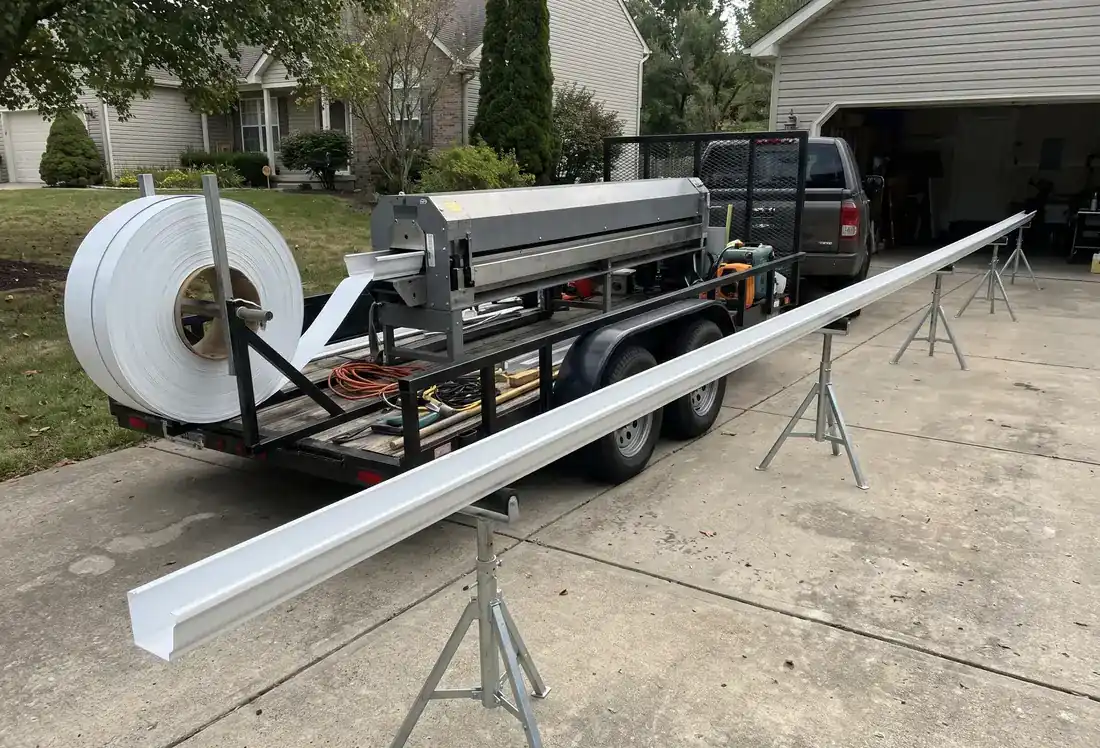
A contractor tows a gutter machine to the house. Painted coil feeds through rollers that bend it into the gutter profile, and the machine cuts each piece to the length measured from the eave. The run is carried to the ladders, fitted with end caps and outlets, and hung on the fascia in one piece.
The result has no joints along its length. A typical Athens house ends up with a handful of joints at corners and ends instead of dozens on a sectional system.
Why do joints matter in Athens?
Every joint is held by sealant and rivets. Sealant ages with heat, sun and moisture, and Athens summers are long, hot and humid, with a record high of 109°F in June 2012, according to Wikipedia. Winters bring the odd hard freeze. Each swing works at the joints.
Joints also catch debris. The lip of a connector inside a sectional gutter is a ledge where pine needles, catkins and roof grit collect and start a dam. In a county with a 58.2 percent tree canopy, the highest of any known US city over 100,000 people, WGAU reported, that matters more than in most places.
Then the rain arrives. Athens averages about 49 inches of precipitation a year, according to Wikipedia. A joint that has opened drips onto the wall and the soil beside the house, and on a raised house that is right above the crawl space vents.
Seamless or sectional?
| Feature | Seamless | Sectional |
|---|---|---|
| Joints along a run | None | Every 10 or 20 feet |
| Where leaks start | Corners and end caps | Corners, end caps and every connector |
| Installed by | A contractor with a machine | Contractor or homeowner |
| Typical metals | Aluminum, steel, copper | Vinyl, aluminum, steel |
| Debris catch points | Few | Every connector |
| Upfront cost | Higher per foot | Lower per foot |
See the seamless vs sectional guide.
Which profiles and sizes are available?
- 5-inch K-style: common on one-story homes with simple roofs.
- 6-inch K-style: more capacity and a stiffer section for two-story homes and large roofs; see 6-inch gutters.
- Half-round: for historic houses in districts like Cobbham and Five Points; see half-round gutters.
- Larger commercial profiles: for long roofs on churches, apartments and commercial buildings.
What thickness should be used?
Aluminum seamless gutter comes mostly in .027 and .032 inch. The thicker coil costs more but dents less when twigs and small limbs land on it, holds its shape when a ladder leans on it, and keeps its line on long runs. Under Athens's canopy, .032 is often worth the difference. See aluminum gutters.
How should seamless gutters be hung here?
- Hidden hangers screwed into the fascia about every 2 feet.
- Slope of about a quarter inch per 10 feet so water does not stand and breed mosquitoes.
- Drip edge in place so water lands in the trough, not behind it.
- Expansion joints on very long runs.
- Outlets placed so downspouts can drain toward ground that falls away from the house.
Colors and historic houses
Seamless coil comes pre-painted in dozens of colors. White, bronze and black are common, or a color matched to the trim. On houses in Athens-Clarke County's local historic districts, changing gutter style or material may need a Certificate of Appropriateness, according to Athens-Clarke County. In newer subdivisions, HOAs may set colors.
Parts on a seamless system
| Term | What it means on an Athens house |
|---|---|
| Seamless gutter | Gutter formed on site from a coil into one piece for each wall, so the only joints are at corners and ends. |
| Coil stock | The roll of pre-painted aluminum, steel or copper that feeds the seamless gutter machine. |
| K-style gutter | The standard flat-backed profile with a shaped front. It holds more water than a half-round gutter of the same width. |
| Hidden hanger | A bracket that clips under the gutter's front lip and screws through the back into the fascia, out of sight. |
| Miter | The cut, riveted and sealed joint at an inside or outside corner, and the most likely place for a leak. |
| End cap | The piece closing each end of a run, crimped and sealed. |
| Outlet | The hole in the gutter bottom where the downspout connects, usually with a riveted drop sleeve. |
| Slope | The fall of the gutter toward its outlet, often about a quarter inch per 10 feet. Too little leaves standing water and mosquitoes. |
What should you ask about seamless gutters?
- What profile and size for each side?
- .027 or .032 coil?
- How many joints, and where?
- What hangers, at what spacing?
- Where will each downspout go?
- Which colors are available, and do I need approval?
Seamless gutters at a glance
| What people ask | Short answer |
|---|---|
| Can seamless gutters be installed in one day? | On most houses, yes, including removal of the old system. |
| Do seamless gutters need expansion joints? | Only on very long runs, where the metal needs room to move with temperature. |
| Can a seamless run be repaired? | Yes. A damaged section can be cut out and replaced, or the whole run re-formed. |
| Do seamless gutters come in copper? | Yes, with the right machine, though copper joints are soldered. |
Where seamless gutters matters around Athens
| Neighborhood or town | Why it comes up there |
|---|---|
| Eastside | Aging builder gutters ready for a seamless upgrade |
| Jefferson | New homes adding gutters to bare sides |
| Watkinsville | Long eaves on large homes |
| Normaltown | Old sectional runs on bungalows |
A first step worth taking
Count the joints on your current gutters, including every connector along each run. If the number is in the dozens and several drip, a seamless system will remove most of those weak points at once.